3 Variant Calling
3 Variant Calling
contact: ludwig@univ-brest.fr
Once the Reads are aligned against a Reference Genome the Variant Calling step will look for differences between the reads and the Reference Genome at each genomic position.

3.1. Tools
Several Algorithms for Germline Variants
| Algorithm | True Positive | False Positive |
|---|---|---|
| HaplotypeCaller ⭐ | 21,707 | 367 |
| FreeBayes | 23,857 | 18,256 |
| SAMtools Mpileup | 25,081 | 2,129 |
| SNPSVM | 17,920 | 65 |
Algorithms for Somatic Variants
- MuTect2
- Strelka
- EBCall
- Seurat
- VarScan2
3.2. Generating a gVCF with Haplotype Caller (GATK4)
gatk HaplotypeCaller \
	-I child.bqsr.bam \
	-R ref.fa \
	-L /DATA/bioinfo/chr12M.capture.bed \
	-ERC GVCF \
	-O child.gvcf.gz
bash-I input bam file
-R reference genome
-L positions covered by the Capture Kit
-ERC GVCF outputs intermediate GVCF
-O output file name
VCFfiles provide information only for sites where at least one sample has a variant allelegVCFfiles (as produced by HaplotypeCaller) provide a genotype for each position and not just variant positions. This is useful to differentiate missing calls from position homozygous to the reference genome.
Sometimes we want to work on a subset of variants, defined by regions. Those regions can for example match a gene/set of genes or the positions taken into account by the capture kit.
The prevaling format to define regions is the BED (Browser Extensible Data) file format. It a tabulated file, with the following columns:
| # | Name | Description |
|---|---|---|
| 1 | chrom | Chromosome (e.g. chr3, chrY, chr2_random) or scaffold (e.g. scaffold10671) name |
| 2 | chromStart | Start coordinate on the chromosome or scaffold for the sequence considered. In base |
| 3 | chromEnd | End coordinate on the chromosome or scaffold for the sequence considered. In base |
- base
- base
[start;end[)
VCF File are numbered in basechr2 11 15 but chr2 10 15 and for just the position 17, you write chr 16 17
3.3. Generate Data for mother and father
At this time only the files for the child are available. Copy the files for the mother and father (and files you may have missed for the child).
cd
/DATA/bioinfo/getmissing.sh
bash
3.4. Combining multiple gVCF files
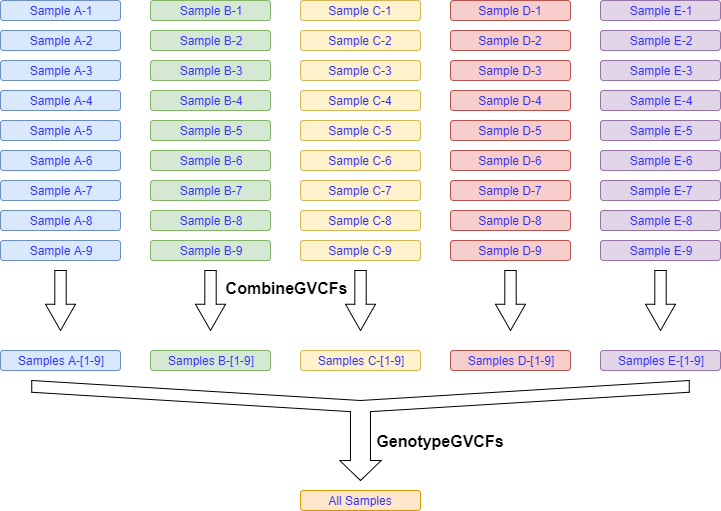
gVCFfiles produced by HaplotypeCaller contain a single sample- The actual genotyping (next step) will need to look simultaneously at the genotype of each sample
- If a large (200+) amount of samples is present, this can be demanding (as the machine needs to keep a great number of very large files open at the same time)
- Combining several mono-sample
gVCFfiles into fewer multi-sample files can greatly speed-up the genotyping and be less resource demanding.
gatk CombineGVCFs \
	-O family.gvcf.gz \
	-R ref.fa \
	-V child.gvcf.gz \
	-V mother.gvcf.gz \
	-V father.gvcf.gz
bash
3.5. Genotyping gVCF files
- This step looks at the genotype of each sample at each position
- It produces biallelic or multiallelic variants and affects genotypes to each sample
- Only variant sites are kept
- Several information (statistics, local frequencies, quality, etc.) are also provided.
gatk GenotypeGVCFs \
	-O variants.vcf.gz \
    -R ref.fa \
    --dbsnp /DATA/bioinfo/chr12M.dbSNP.146.b37.vcf.gz \
    -V family.gvcf.gz
bash
3.6. Recalibrating Variant Quality Scores
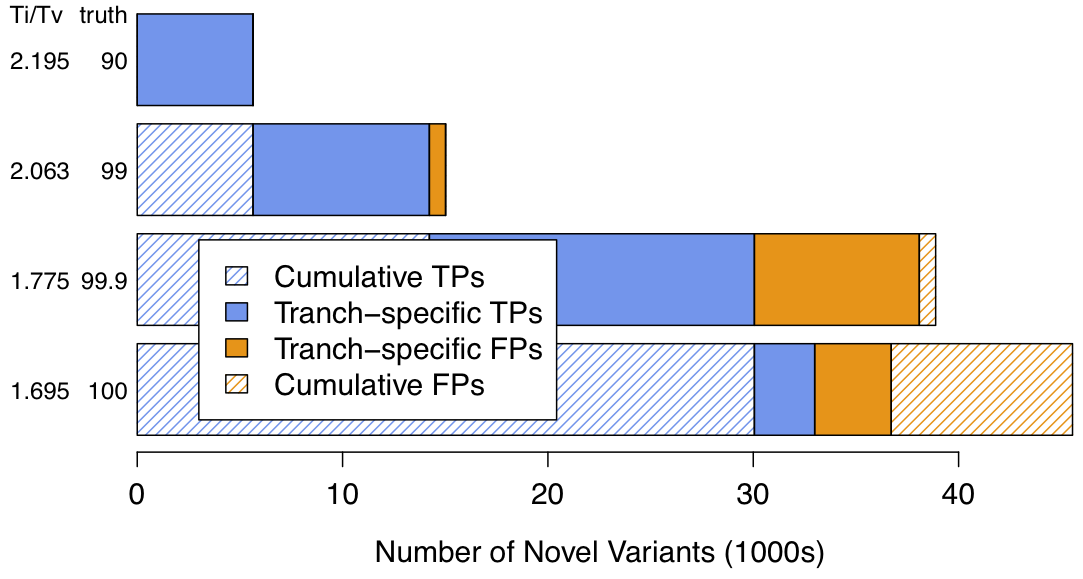
Calculates a new quality score called VQSLOD (Variant Quality Score Log-Odds)
- Allowing to finely balance sensitivity (less FNs) and specificity(less FPs)
- Uses Machine Learning to affect a score based on various contextual information
- Trains on highly validated variant data (omni, 1000g, hapmap)
- ⚠ Large amount of data is needed to perform this step! At least exome wide and with as many samples as possible
- The user defines a set of quality tranches, containing a certain amount of True/False Positives
- Later, these tranches will be used to filter out data, depending on the needs.
3.7. VCF File Format
A VCF File, is a text file consisting of a Header (starting with #) and record lines. Each line refers to a genomic position bearing one or more variants.
There should only be a line if at least one sample carries one of the variant alleles.
The data in the lines are distributed over several columns :
| # | Column | Description | Examples |
|---|---|---|---|
| 1 | CHROM | the chromosome of the variant site | 12, chr17, X, chrY |
| 2 | POS | the start position of the variation | 156701805 |
| 3 | ID | an identifier for the variant | empty, ., rs179811, anything |
| 4 | REF | the allele in the Reference Genome at the given position | A |
| 5 | ALT | the list of alternate alleles present in the samples | C,G |
| 6 | QUAL | the variant calling quality | 1256.3 |
| 7 | FILTER | a list of reasons why we should ignore this variant | ., PASS, VQSTRTranche90to99 |
| 8 | INFO | Metrics and annotation about this variants | |
| 9 | FORMAT | List of fields contained in the following samples columns | GT:DP:AD:PL:GQ |
| 10+ | samples | one column per sample, containing the genotype and other values | 0/1:33:16,17:65,0,870:65 |
Allele Numbers
The Reference allele REF is numbered 0
The Alternate alleles ALT1, 2, n
Example with REF=A and ALT=C,G
- 0 ➡A
- 1 ➡C
- 2 ➡G
- . ➡ unknown
Genotypes
Human having 2 chromosomes in each pair, 2 values are expected. Those values are separated by /or |
Example with REF=A and ALT=C,G
- 0/0 ➡ A/A
- 0/1 ➡ A/C
- 1/1 ➡ C/C
- 1/2 ➡ C/G
- ./. ou . ➡ missing
/ indicates unphased genotypes and | indicates phased genotypes
- if a given individual has a variant
A/C, then a variantG/T➡this individual has an alleleAandC, then an alleleGthenT - if a given individual has a variant
A|C, then a variantG|T➡ allelesAandGare on the same chromosome and allelesCandTare on the other chromosome. ThusAGandCTform haplotypes
To answer the following question we'll examine the variants.vcf.gz file. We'll use the commands seen previously (zcat, cut, grep, wc, ...)
3.7.1. What is the version of this VCF file ?
Look at the fileformat header.
use grep
3.7.2. Which version of GATK was used to produce this files ?
Look for GATKCommandLine in the header.
use grep
3.7.3. What is the meaning of the following keyword ?
AC(defined in the INFO header)GT(defined in the FORMAT header)DP(defined in the FORMAT header and the INFO header)GQ(defined in the FORMAT header and the INFO header)
use grep
3.7.4. List the individuals (samples) in this file
use grep, tail and cut
3.7.5. How many variants are there in this file ?
That is:
- Number of variants sites ➡easy
- Number of variants alleles ➡ harder
use grep -v, wc (and cut, tr)
3.7.6. How to differentiate SNVs, insertions, deletions and multiallelic variants ?
Look at the variants starting with C:
zcat variants.vcf.gz | grep -v "^#" | cut -f4,5 | grep "^C" | sort -u | column -t
bash
3.7.7. Examine the following variants
- 12:11214360 (rs73260771)
- How many samples have the following alleles: A, C and T ?
- What is the allele count for the alleles A, C and T ?
- 12:9833524 (rs3764022)
- How many samples are homozygous / heterozygous ?
- What is the GQ values for each sample ?
- What is the DP values for each sample ?
- 12:129298819 (rs3741614)
- How many alternates are substitution, insertion, deletion ?
- How many genotypes are phased / unphased ?
Next Step: 4 Databases and Viewers